

How to make the most of your Teacher membership
Mindomo Teacher is designed for educational personnel who want to help students think critically, investigate, and analyze the information they receive.
For Who and Why?
Section titled “For Who and Why?”Educational personnel include teachers (both specialized and general), librarians, paraprofessionals, and other related personnel who provide educational services. Mindomo Teacher can also be used by parents who choose to homeschool their children for many different reasons.
Teachers who use this subscription can:
- prepare visual lesson plans that include images, videos, and audio materials
- create assignments to help students acquire critical thinking skills so they can clearly and objectively understand and explain what they learn
- organize and structure research information and teaching material
- adapt the curriculum to student needs
Librarians can use this subscription to:
- organize, manage, and share information within the academic community
- assist students, teachers, and researchers with their research activities
Parents homeschooling their children can use this subscription to:
- structure, organize, and summarize researched material in a visual manner
- present the information to be taught and highlight key points and terminology
Help students design their learning
Section titled “Help students design their learning”Help students design their learning by guiding them to think critically and independently. Mindomo empowers learners to understand concepts deeply, ask meaningful questions, and make connections between ideas using visual diagrams that promote autonomy and thoughtful reasoning.
Facilitate Learning for Students
Section titled “Facilitate Learning for Students”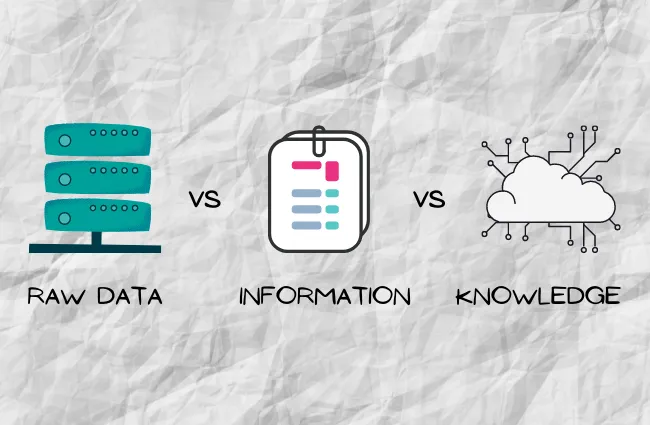
Show students how to think, and you’ll actively involve them in their learning rather than asking them to memorize the right answers.
Students will put their minds in motion and question ideas to gain a better understanding.
Once you spark their curiosity and desire to understand, students will seek knowledge rather than simply collecting data and information.
Autonomy for Each Student
Section titled “Autonomy for Each Student”
Give students the gift of autonomy, helping them think for themselves in uncertain and complex situations where judgment is more important than routine.
Being autonomous means students will have the intellectual confidence to be bold and express their ideas rather than simply being well organized.
As long as they have logical arguments, they won’t be afraid to challenge conventional thinking.
Why Mind Maps?
Section titled “Why Mind Maps?”Discover why mind maps are effective for teaching and learning: they align with how the brain processes information, help connect visual and analytical thinking, and encourage critical thinking by organizing ideas clearly and meaningfully.
Fit the way our brain works
Section titled “Fit the way our brain works”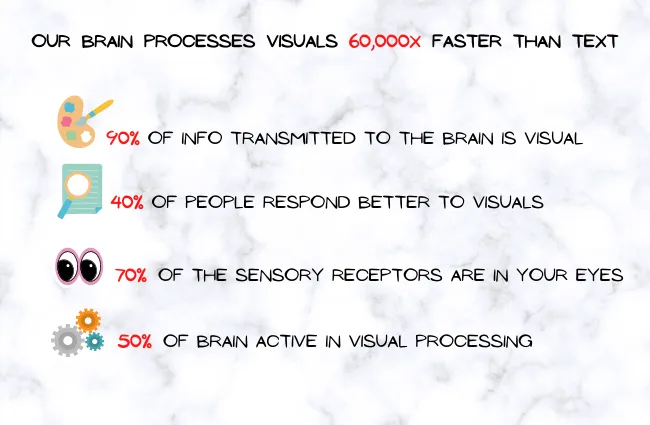
Using mind maps for teaching and learning fits the way our brains work. That familiar saying, “a picture is worth a thousand words,” is backed by science. Our brains process visuals up to 60,000 times faster than text.
Studies also show that our brains not only process visuals faster than words but retain and transmit much more information when it is delivered visually.
Combine right and left hemispheres
Section titled “Combine right and left hemispheres”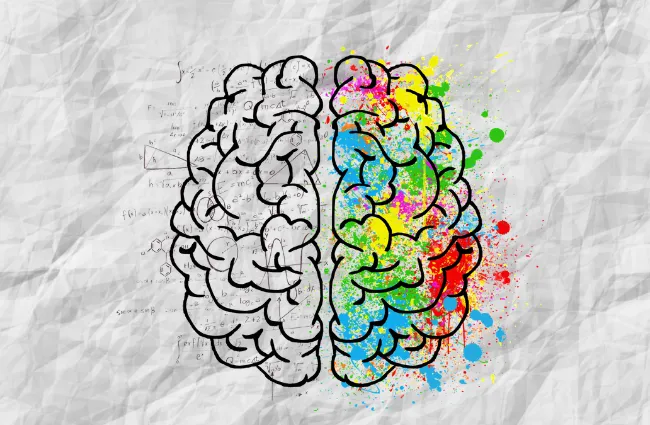
Our brains have two major hemispheres, each with its own way of thinking and processing information. The left side is logical, linear, and analytical. The right side is intuitive, creative, and visual. Only by using both sides consistently can students grow personally and professionally.
Mind mapping brings the right and left hemispheres together.
Breaking information into concepts and organizing them hierarchically engages the left hemisphere. Using shapes, images, and colors engages the right hemisphere. The left brain visualizes the overall structure, while the right brain identifies the steps necessary to complete the map.
Prompt critical thinking
Section titled “Prompt critical thinking”
Beyond the visual aspects, the mind map creation process encourages students to develop a healthy habit of questioning and reasoning.
First, they take the information they know or receive in class and identify the topic or thesis.
Then, they break everything into smaller pieces based on importance and hierarchy.
Third, they look for connections between new information and what they already know.
Throughout the process, students engage in synthesis, analysis, interpretation, explanation, evaluation, generalization, comparison, and contrast.
How does Mindomo support learning?
Section titled “How does Mindomo support learning?”Mindomo supports learning by enabling collaborative and inquiry-based activities, helping students develop soft skills and critical thinking, and by making complex information easier to understand through visual diagrams and multimedia.
Relaxed collaboration
Section titled “Relaxed collaboration”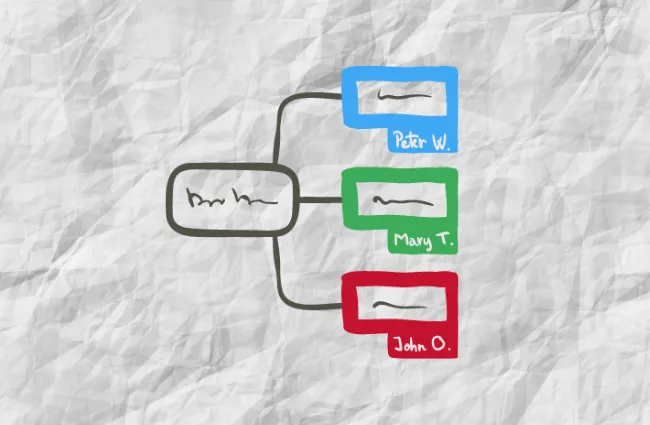
As students will likely work and collaborate in teams in the future, they need support in developing soft skills such as flexibility, problem-solving, and decision-making.
Mindomo is a highly visual and spatial platform accessible on desktops, laptops, and mobile devices, allowing students to collaborate inside and outside the classroom and beyond the school day.
While working on the same diagram, some students identify key points, while others see connections and generate new ideas. Having everything organized helps students feel better prepared, less anxious, and more eager to participate.
Inquiry-based learning
Section titled “Inquiry-based learning”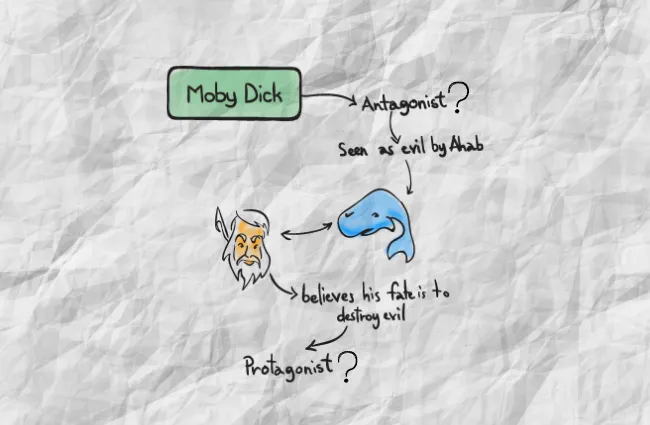
Teachers act as guides-on-the-side, empowering students to ask questions and find answers themselves by creating diagrams. While the process may seem messy at times, students learn and understand concepts at a rapid pace because they aren’t spending time on what they already know.
Creating diagrams in Mindomo guides students through all phases of inquiry-based learning:
- Interaction – researching different media sources to identify the central topic of the inquiry
- Clarification – summarizing and categorizing information in a diagram of their choice
- Questioning – asking relevant questions to drive self-directed inquiry
- Design – creating an accessible, relevant, and engaging diagram to support inquiry
Information overload off
Section titled “Information overload off”
Mindomo allows teachers and students alike to visualize complex concepts using a wide range of multimedia—images, symbols, videos, hyperlinks, voice notes, and more.
Creating diagrams enables students to:
- simplify information
- prioritize key aspects
- organize their thoughts on an infinite canvas where erasing, editing, and reorganizing content is just one click away
Study activities with Mindomo
Section titled “Study activities with Mindomo”Explore a variety of study activities students can do with Mindomo, from brainstorming and integrated curriculum tasks to creative reasoning and project‑based exercises, all designed to deepen understanding, foster collaboration, and make learning more engaging.
Brainstorming Exercises
Section titled “Brainstorming Exercises”
Brainstorming is often the ideal way to introduce mind mapping to students. With few or no rules, students are encouraged to be spontaneous and write whatever comes to mind. They freely associate ideas with a topic, creatively exploring any path their thinking may take.
💡 Tips and Tricks
Brainstorming exercises make great icebreakers and can be adapted in many ways to make them more engaging or more focused:
Blank cluster diagram – ready to use for any topic. Students can freely associate ideas with the main topic.
Brainstorming with cues – guide sessions using verbal cues, visual cues, or a combination of both. Share pre-filled concept maps that require further editing. Consider browsing Mindomo’s gallery for inspiration, such as this map template.
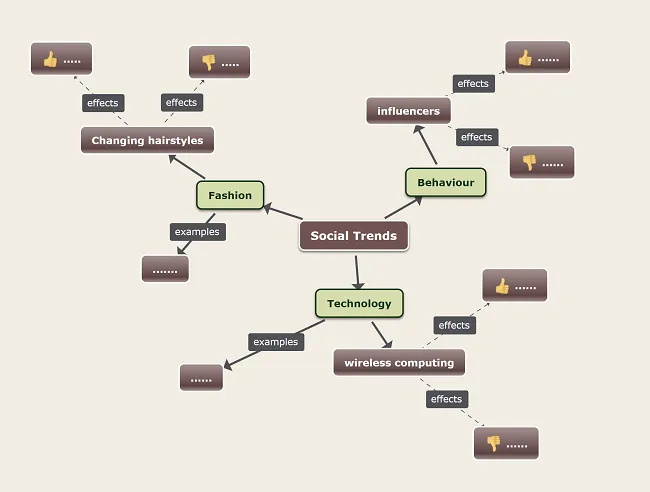
Guided brainstorming on specific topics, such as social and environmental issues, daily activities, argument or opinion essays, cause-and-effect essays, descriptive or narrative essays, facts and opinions, pros and cons, history, ethics, travel, cooking, free time, or future plans.
Have students create diagrams around open-ended questions, for example:
What challenges did WWII create? What are the best things about being part of a family? What could your school do better to improve student experience? If you had a million dollars, what would you spend it on? What do you like most about yourself?
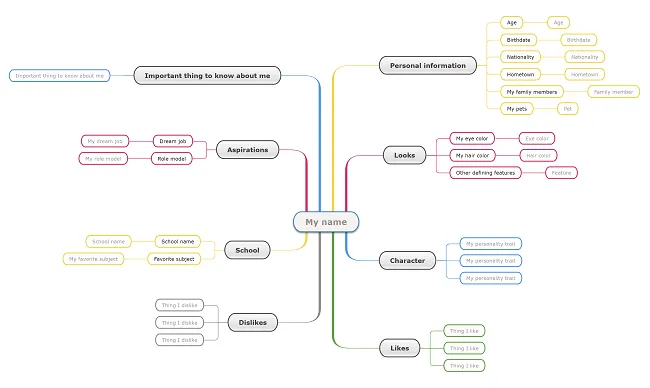
Working individually or in small groups, students should reflect on the questions and create mind maps highlighting key ideas. These maps can encourage further discussion when presented to the class.
Revisiting the same questions months later can help demonstrate growth in independent thinking skills.
Language brainstorming can focus on the four core language skills: listening, speaking, reading, and writing.
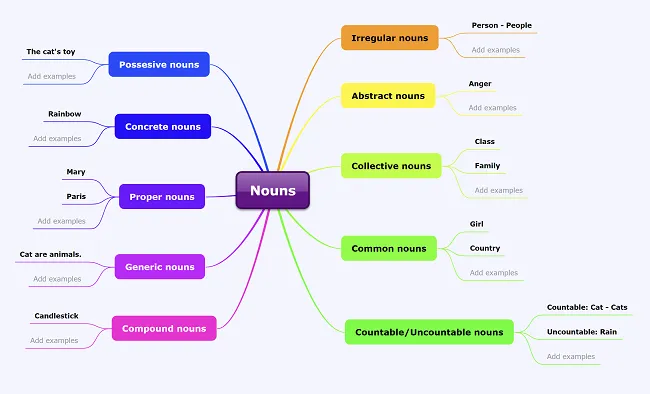
Find inspiration in Mindomo’s templates gallery, for example:
- parts of speech
- nouns
- syntax
- English verb tenses
- collocations
- irregular verbs
- pronouns
- adverbs
- linking words
Integrated Curriculum
Section titled “Integrated Curriculum”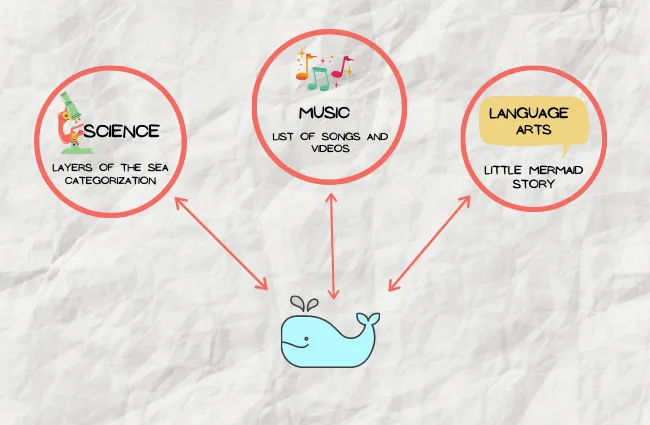
Connect different areas of study by crossing subject-matter boundaries and emphasizing unifying concepts. The goal is to make connections visible and meaningful for students, enabling them to engage in relevant, real-life learning activities.
Traditionally, students have been taught subjects in isolation—for example, reading comprehension only in language classes and math only in mathematics classes. However, certain math concepts can also be effectively taught in science, as the two areas are closely related.
Teachers can integrate history, geography, economics, and government within an interdisciplinary social studies program. Students tend to retain information better when they relate content to real-world connections.
💡 Tips and Tricks
Encourage students to highlight main concepts using different topic styles for each subject—for example, red for math, blue for philosophy, and green for history.
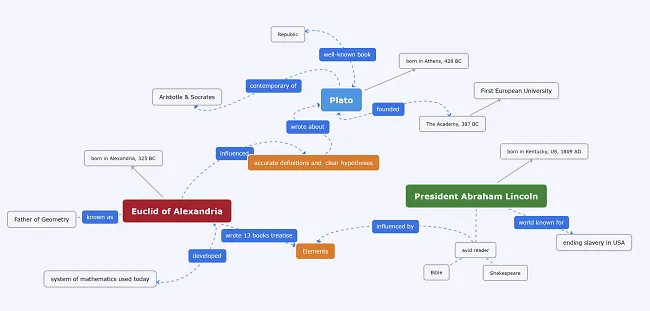
Use this cross-disciplinary concept map with your students.
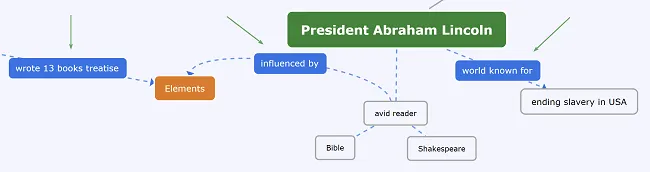
Emphasize unifying concepts by applying the same topic color and shape.
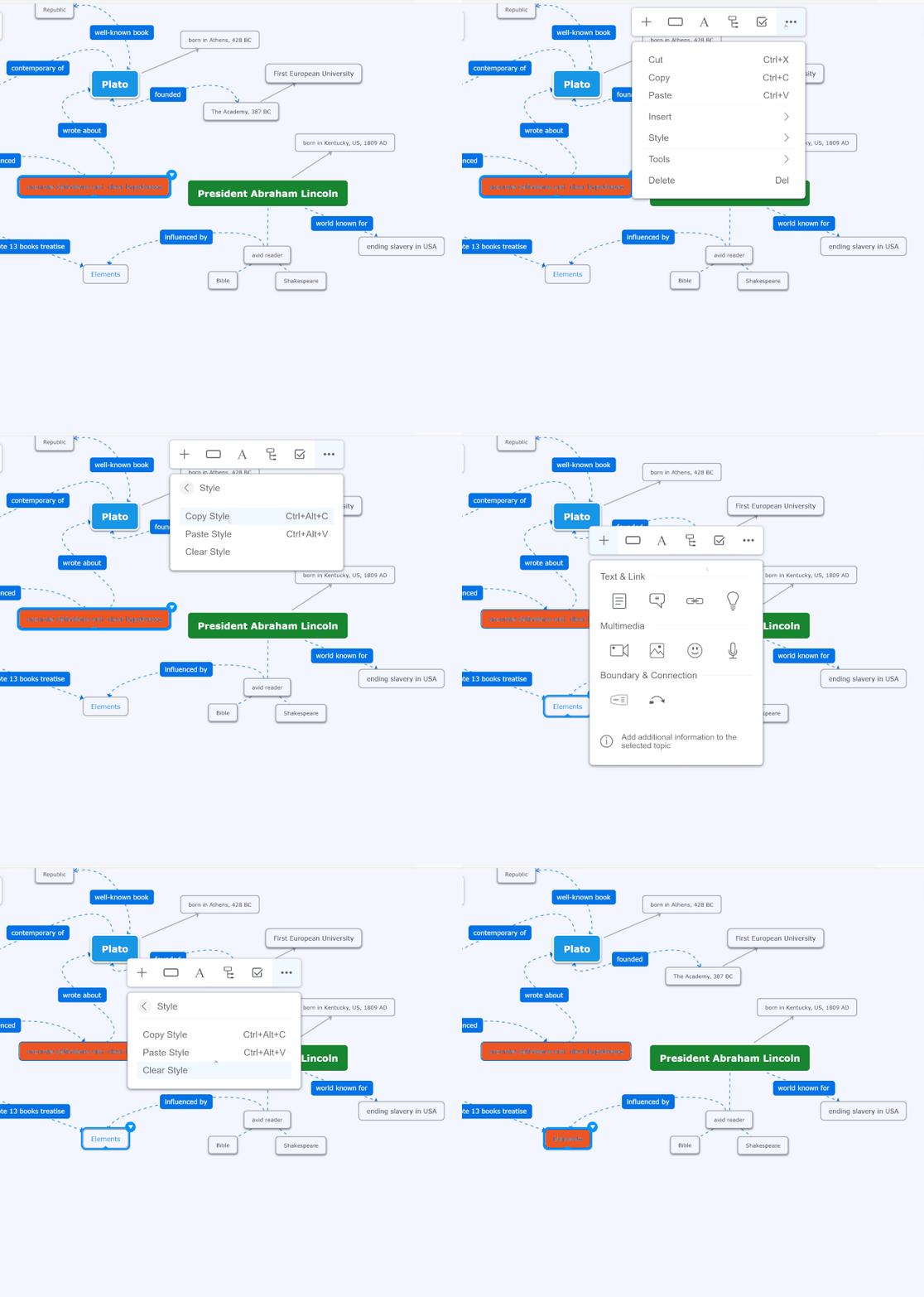
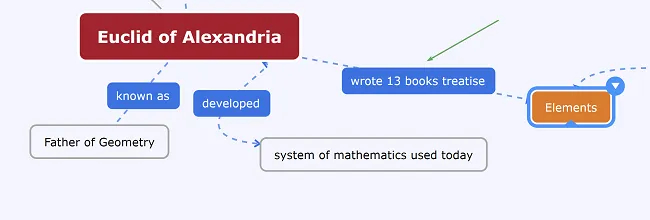
Students should write short explanations on relationship lines between unifying concepts to leave breadcrumbs of their reasoning.
Read more about concept map creation here.
Creative Reasoning
Section titled “Creative Reasoning”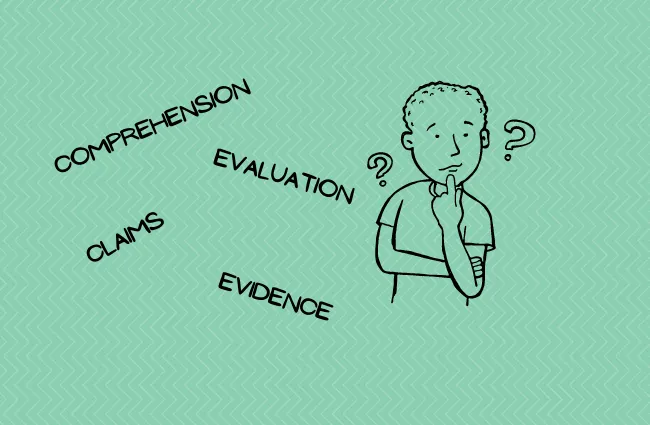
Reasoning occurs when we take information, compare it with what we already know, and draw conclusions. Strong reasoning skills support students’ comprehension, evaluation, and ability to present claims and arguments. They are also essential for developing coherent viewpoints grounded in relevant knowledge.
In short, students need solid reasoning skills to make informed decisions, distinguish right from wrong, and solve complex problems. Mind mapping makes students’ reasoning visible and open for exploration.
💡 Tips and Tricks
To strengthen reasoning skills, ask students to create maps showing levels of influence. They can choose a significant topic or event—such as the late 2000s economic crisis—and place it at the center of the map. From there, they identify the events and factors that contributed to it.
Complex topics require students to categorize existing knowledge, seek new information, and examine causal relationships. While building their maps, students should keep cause-and-effect question stems in mind.
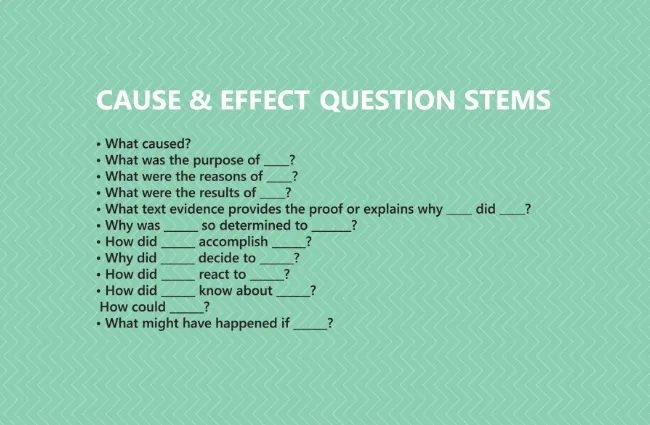
Students map the first level with primary impacts (causes), followed by secondary impacts (effects), continuing outward until the topic is fully explored.
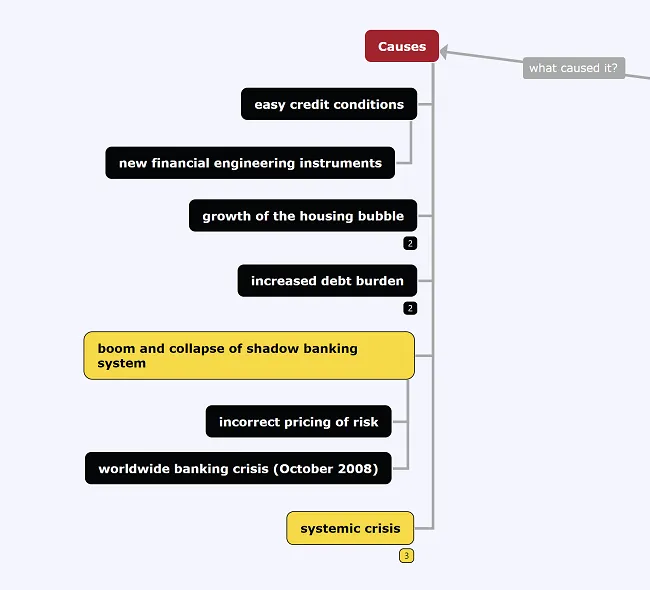
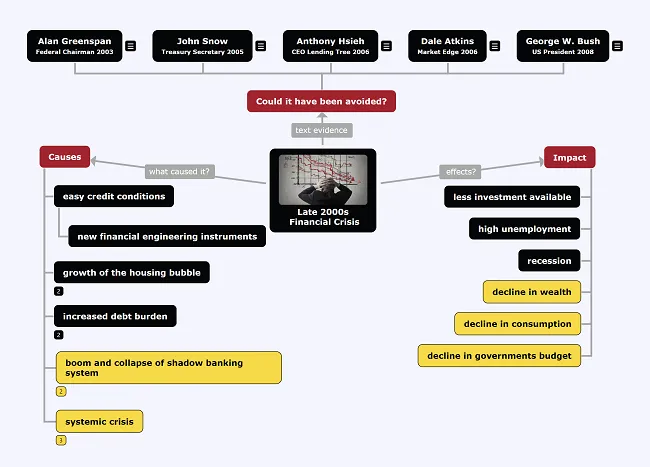
Use this cause-effect mind map as a starting point.
Essay Writing
Section titled “Essay Writing”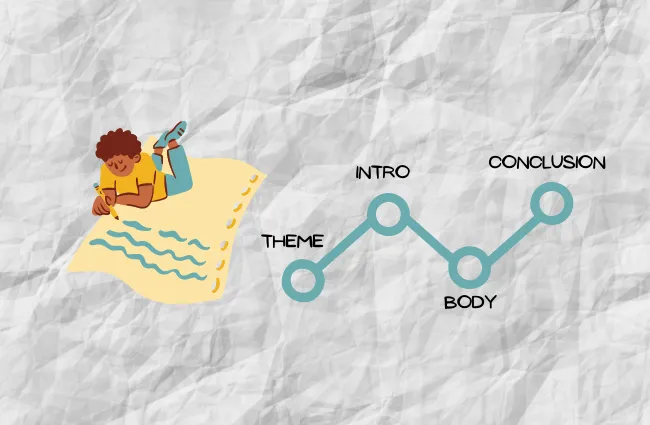
A good essay is structured and organized. It tests students’ key reasoning skills, such as analysis, evaluation, and synthesis.
Mindomo guides students from the complex to the simple, helping them draft an essay that is clear and on-topic for both themselves and their audience.
Advise students to start with a skeleton that contains everything: research, inspiration from similar essays, text fragments, and notes.
At first, they can include everything they find relevant. Then, they should review the information twice and reorganize it so it makes sense. Using colors and shapes for highlights can help. The more familiar students become with the topic, the easier it will be to write about it.
In the end, students should aim to create a coherent draft with arguments, counterarguments, examples, quotes, and properly referenced sources.
💡 Tips and Tricks
Use Mindomo’s predefined essay templates as inspiration or ready-to-edit mind maps.
A descriptive essay describes something—an object or person, an event or place, an experience or emotion, or an idea. The student’s goal is to provide enough detail for the audience to clearly understand the chosen topic.
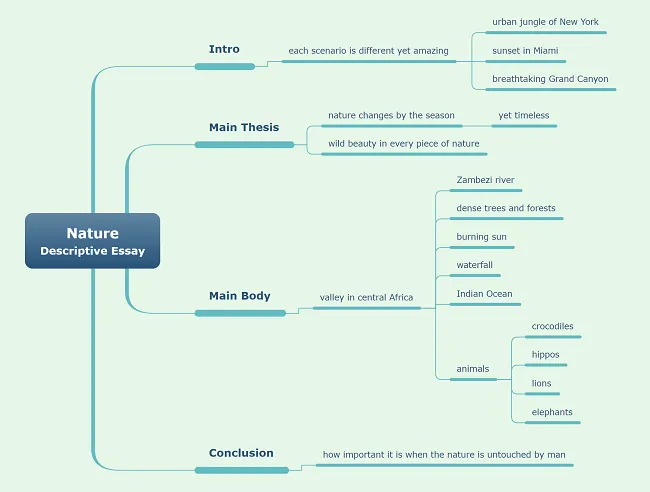
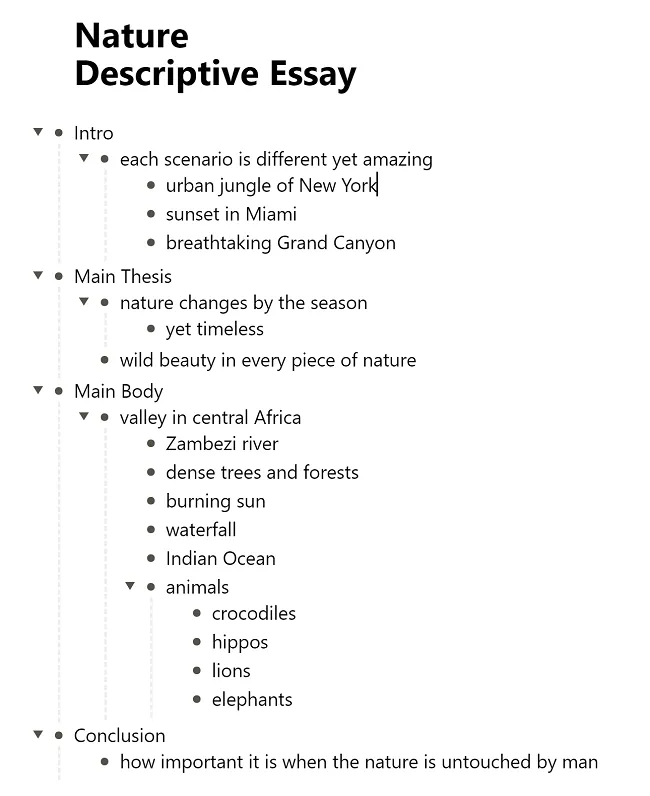
At any time, students can turn the mind map into an outline to organize what they plan to write.
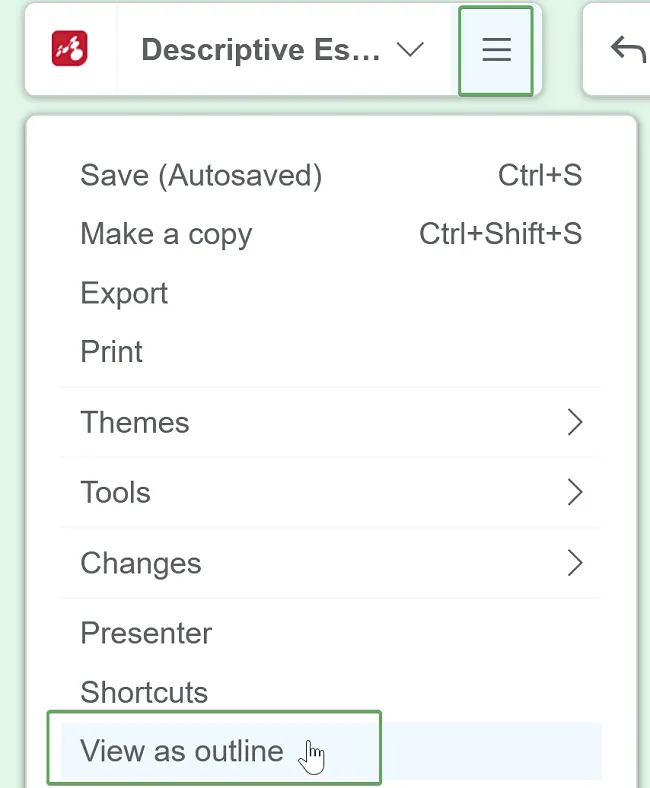
Editing in the outline view makes writing easier and brings students closer to the final draft.
If inspiration strikes, students can write notes for later proofreading.

An argumentative essay uses evidence and facts to support its claim. The student’s goal is to persuade the reader to agree with their argument, relying on evidence rather than personal opinion alone.
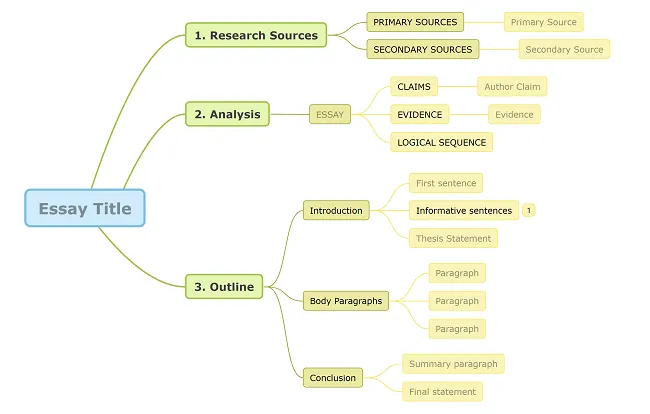
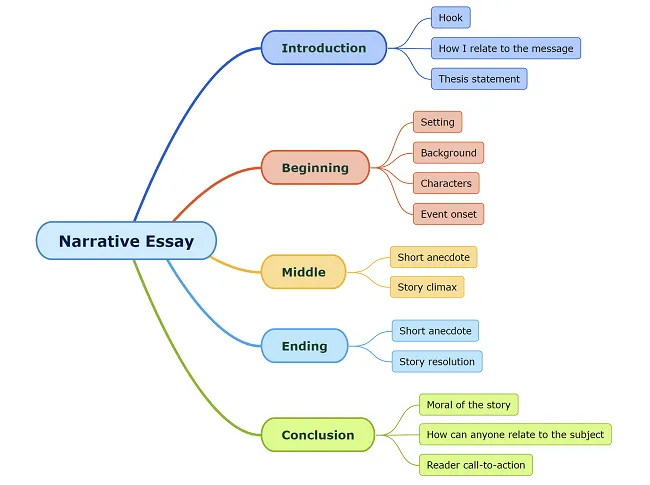
A narrative essay has a single motif or central idea around which the entire narrative revolves. All events and characters support this core idea. Similar to a traditional five-paragraph essay, it follows the same general structure.
With an expository essay, the goal is to explain, illustrate, or clarify a topic for the reader. It may involve investigation, evaluation, or argumentation aimed at clear understanding.
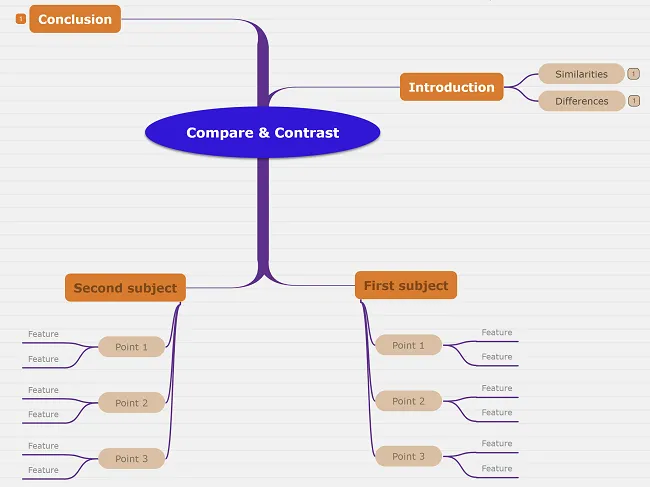
This essay type includes subcategories such as:
- cause-and-effect essays
- problem–solution essays
- compare-and-contrast essays
(similarities-to-differences,
point-to-point,
whole-to-whole)
Since any mind map can be turned into an outline, students can write their essays from scratch and print them directly from Mindomo.
Quick Summarizing
Section titled “Quick Summarizing”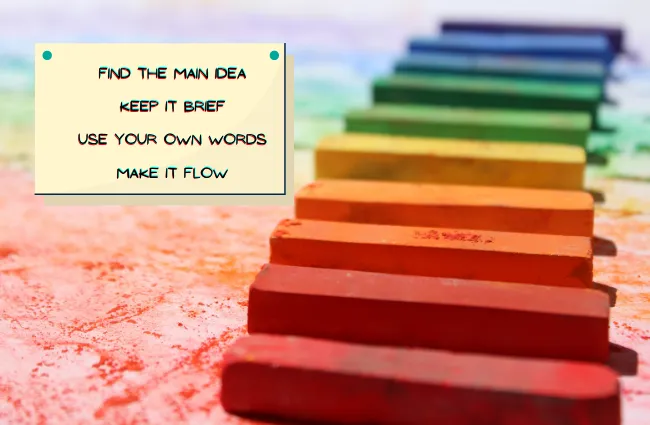
Summarization supports understanding, retention, and long-term recall. It helps students become more purposeful, active readers, thinkers, and learners.
If you want students to read for understanding, encourage them to summarize using mind maps.
When creating a mind map, students develop a healthy habit of questioning and reasoning. First, they identify the main thesis. Second, they break information into smaller pieces based on importance and hierarchy. Key ideas—such as chapter numbers, quotes, theories, experiments, writing style, or personal reflections—become main topics, while details branch out as subtopics. Third, students look for connections between new information and prior knowledge.
Using shapes, images, and colors strengthens memory retention. Books—whether newly read or revisited years later—become easily accessible anytime, anywhere.
💡 Tips and Tricks
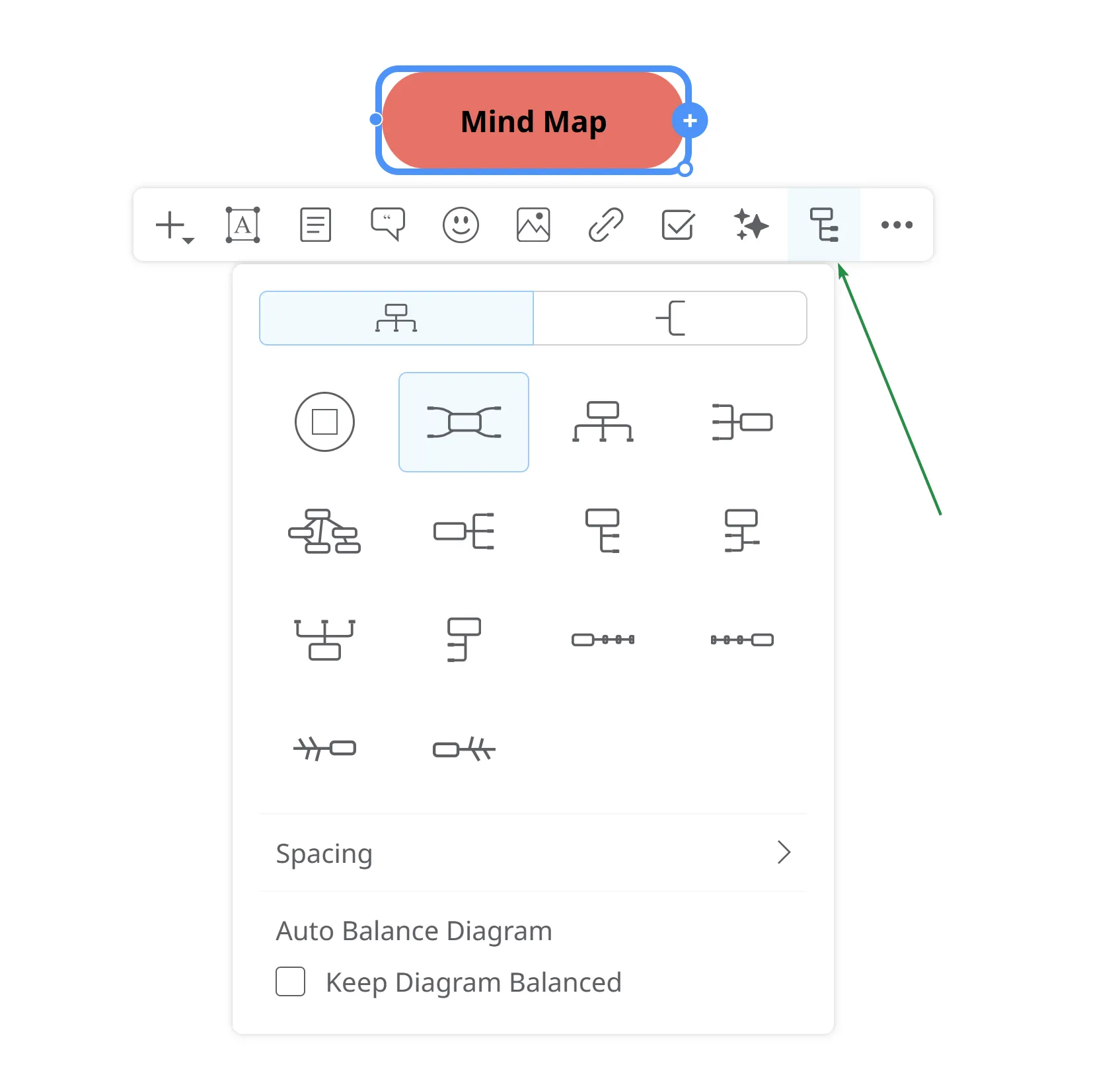
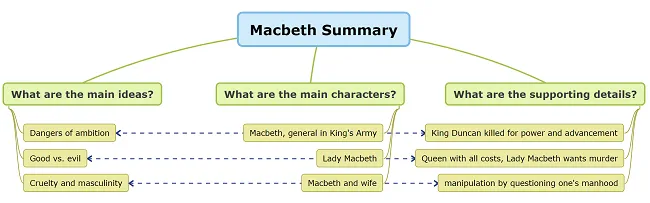
Students should create a descriptive summary to express their understanding of the author’s message. Left- and/or right-sided org chart layouts highlight cause-and-effect relationships between main ideas and supporting details.
Encourage students to build their diagrams using the following framework questions.
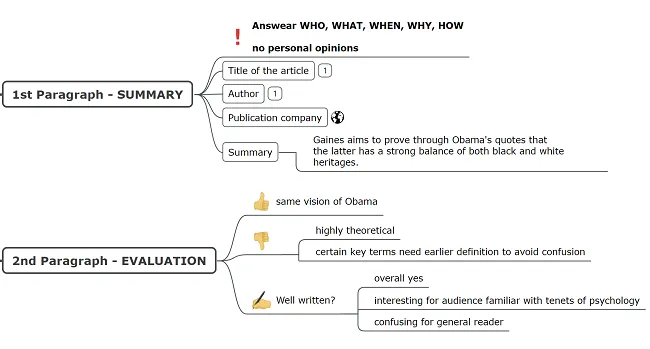
An evaluative summary is useful when students need to assess a text’s usefulness, validity, or strength of argument. This type of summary is opinion-focused. Students should list basic facts such as the title, author, and main point then focus on their evaluation.
Do they agree or disagree with the author? Why? Is the text well written?
Right- and/or left-sided layouts work well for structured overviews, presenting information in the order of the summary. Colors and emojis can highlight key evaluative points.
Project-based Learning
Section titled “Project-based Learning”
Project-based learning prepares students to explore real-world problems and collaborate with peers to find solutions.
Mindomo allows students to work as a team to ideate, brainstorm, and solve problems. Each student contributes through ongoing research and input, some of which may occur outside the classroom and may even involve colleagues or teachers from other schools.
Students can collaborate in Mindomo anytime, anywhere, from any device, as long as they have an internet connection.
💡 Tips and Tricks
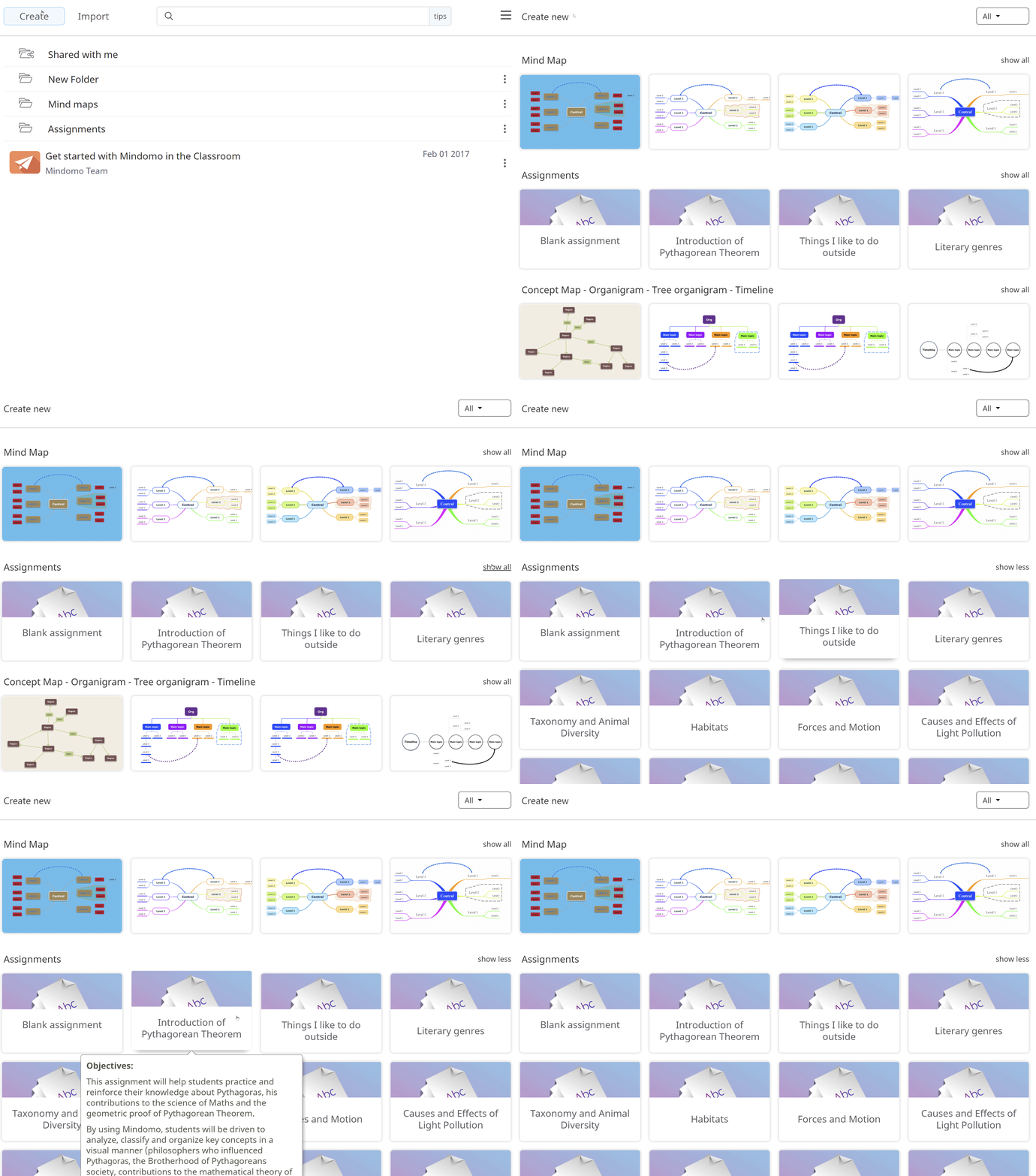
Set up a collaborative mind map assignment that enables instant sharing between you and your students. You can start from scratch or use one of Mindomo’s predefined templates.
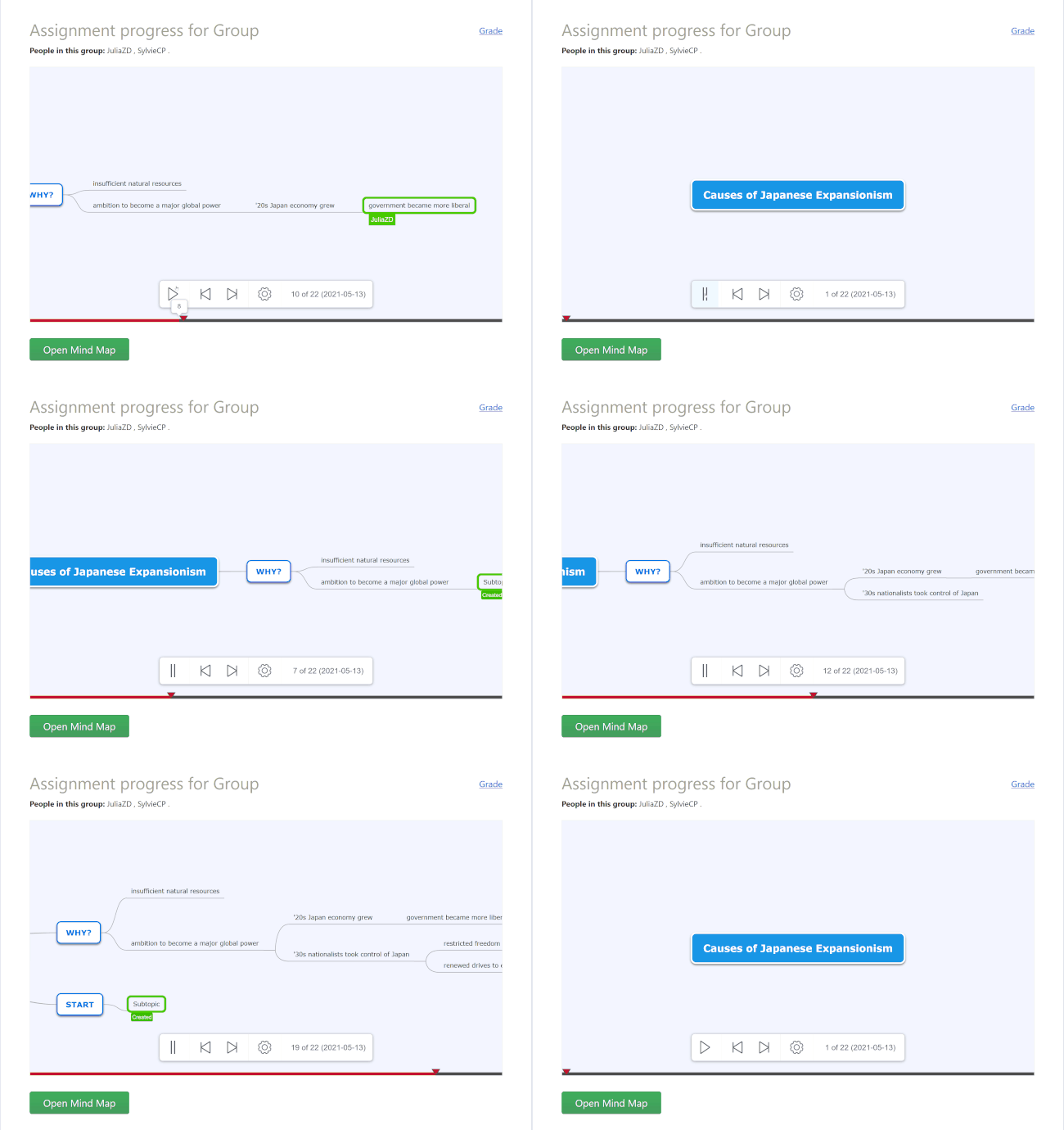
Use Playback mode to clearly visualize each student’s diagram changes.
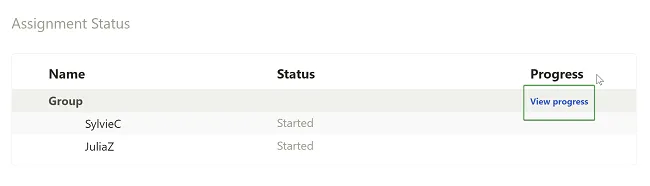
You can also provide real-time feedback, grading, and assignment updates.


Speech Preparation
Section titled “Speech Preparation”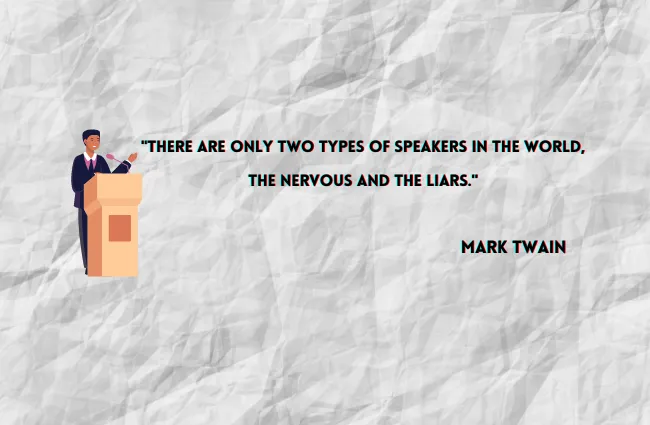
The purpose of writing or delivering a speech is to convince the audience to support an idea or pay attention to a specific topic. Whether the speech is for teachers or classmates, students should focus on building the foundation for clear and confident speech delivery.
Before drafting their speech, students should consider the following questions:
Who is the audience?
Why are you giving the speech—what do you want the audience to think, feel, or do?
What is the speech about?
How long should it be (for example, 3–5 minutes)?
💡 Tips and Tricks
Right- and/or left-sided layouts are effective for outlining key information in an organized way. Students should rank main points by importance and logical sequence within the speech.
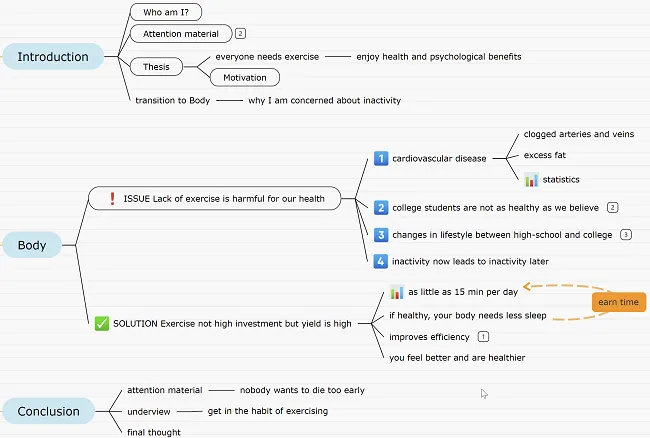
Icons and emojis are ideal for highlighting key aspects—problems, solutions, statistics, explanations, and more.
Encourage students to organize supporting research that strengthens their points. They can also add videos to help retain important information.
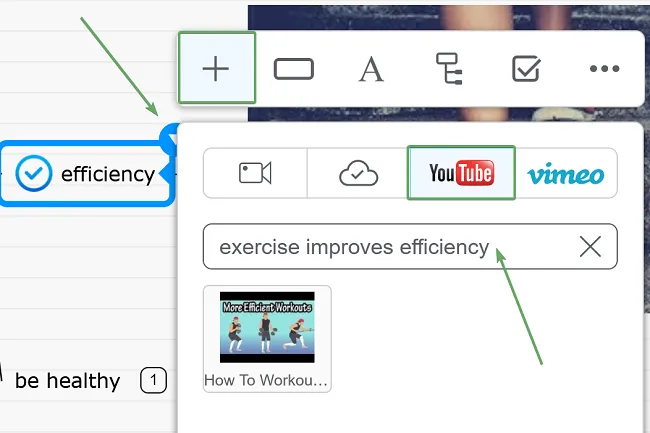
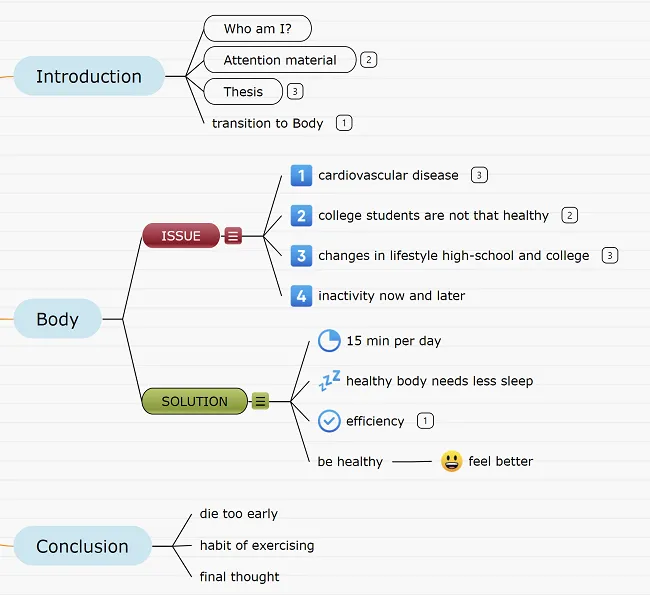
Rehearsing before delivery. During the final review, students can simplify the content and leave only keywords and phrases visible. This simplified diagram can serve as a visual aid during the speech.
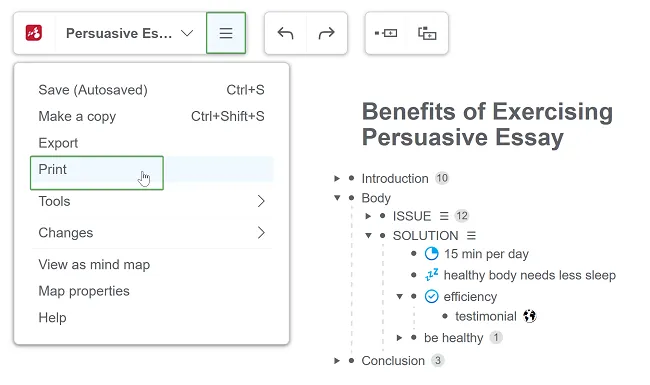
Turning the map into an outline and printing it as a handout allows the audience to follow along and use it as a reference during the presentation.
Class Presentations
Section titled “Class Presentations”
Students can create presentations directly from their diagrams and use them to present ideas, projects, and assignments creatively.
This approach saves time by eliminating the need for a separate presentation tool and avoiding repetitive copying and pasting.
💡 Tips and Tricks
Use an easy-to-follow structure—introduction, body, and conclusion—by choosing either a mind map or a concept map layout.
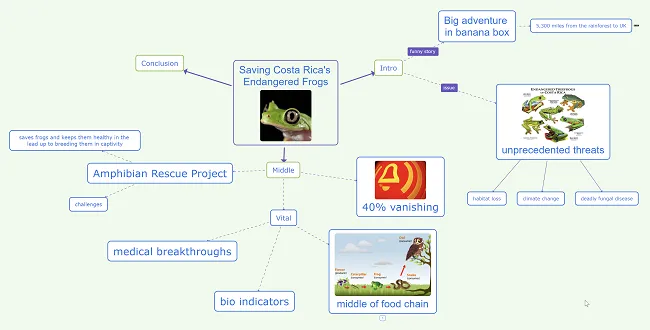
Encourage students to limit their presentations to 10 slides total and no more than six words per slide. This helps the audience process on-screen content alongside the spoken message.
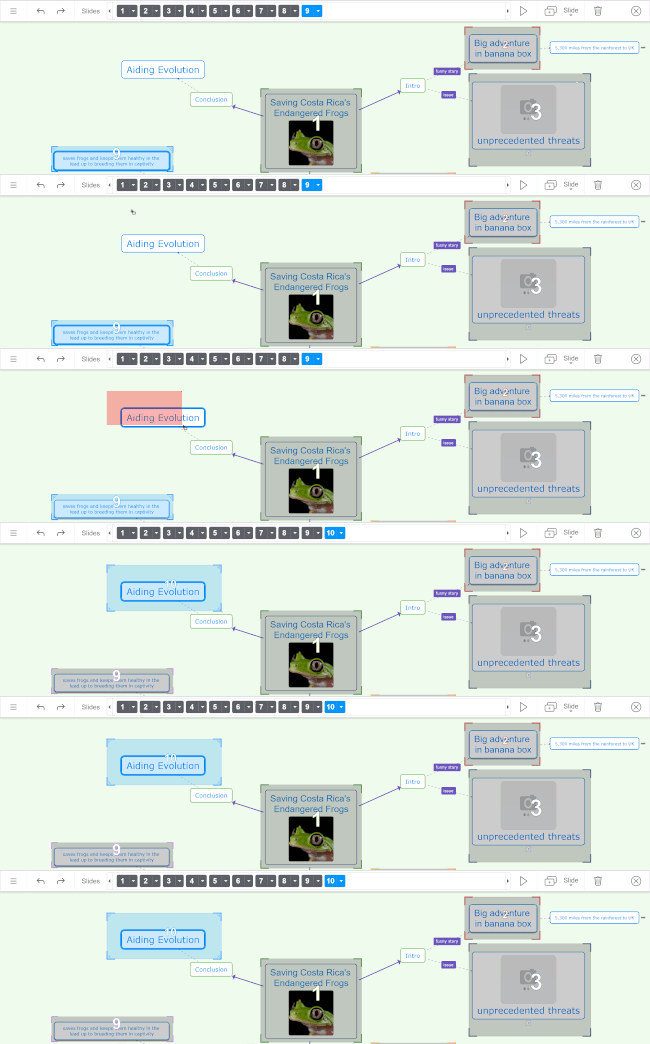
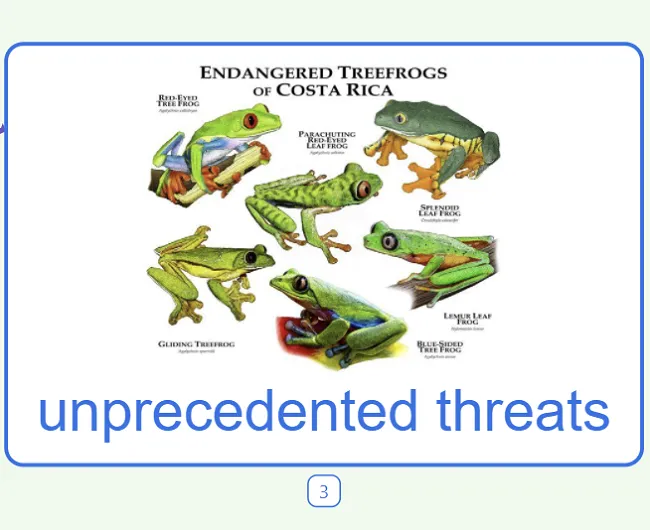
Compelling images and videos communicate ideas efficiently and make information easier to remember.
To maintain a consistent look and feel, use only two or three colors and apply the same font type, size, and formatting throughout. Students can format one topic and then use the copy style option to apply it to the rest.
For a smooth delivery, Mindomo supports the use of a clicker or remote, allowing students to face the audience instead of turning back to change slides.
Research
Section titled “Research”
From research for school projects to undergraduate-level studies, Mindomo helps students:
- develop critical thinking and analytical skills
- expand knowledge and understanding of a chosen field beyond the classroom
The type of research students conduct determines the resources they need. Visualizing and managing research materials is just as important as integrating them into the research process. Common resource types include:
- Primary sources (original documents or firsthand accounts, such as letters, official records, interviews, and survey results)
- Secondary sources (analyses, evaluations, and interpretations of primary sources)
💡 Tips and Tricks
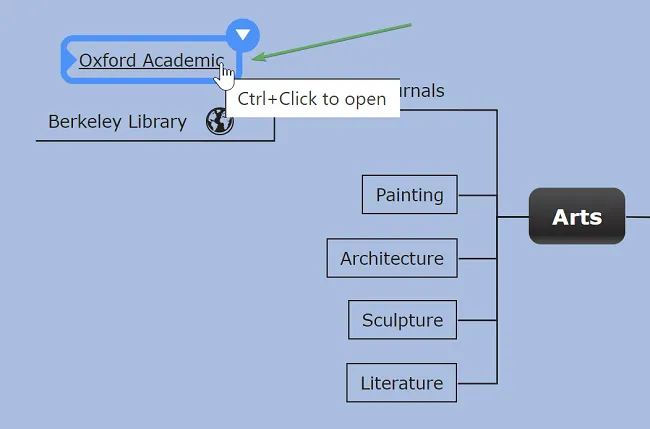
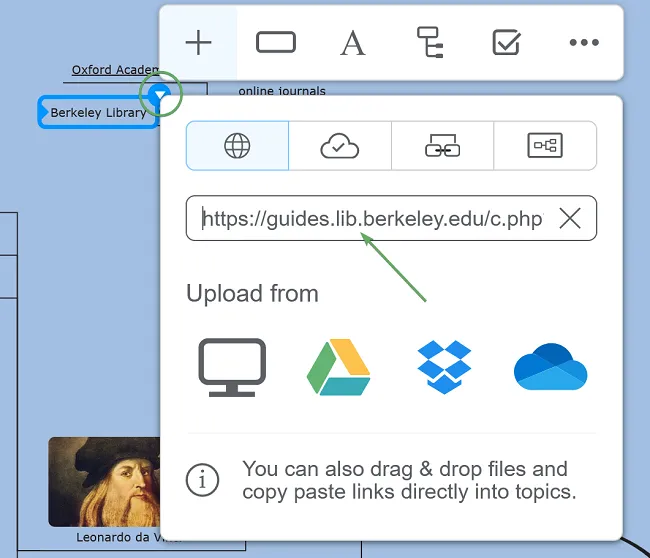
For book excerpts, brochures, journals, magazines, newspapers, or case studies, students can take photos and upload them or create hyperlinks to online sources. Hyperlinks can be added to specific words or phrases or included as topic attachments.
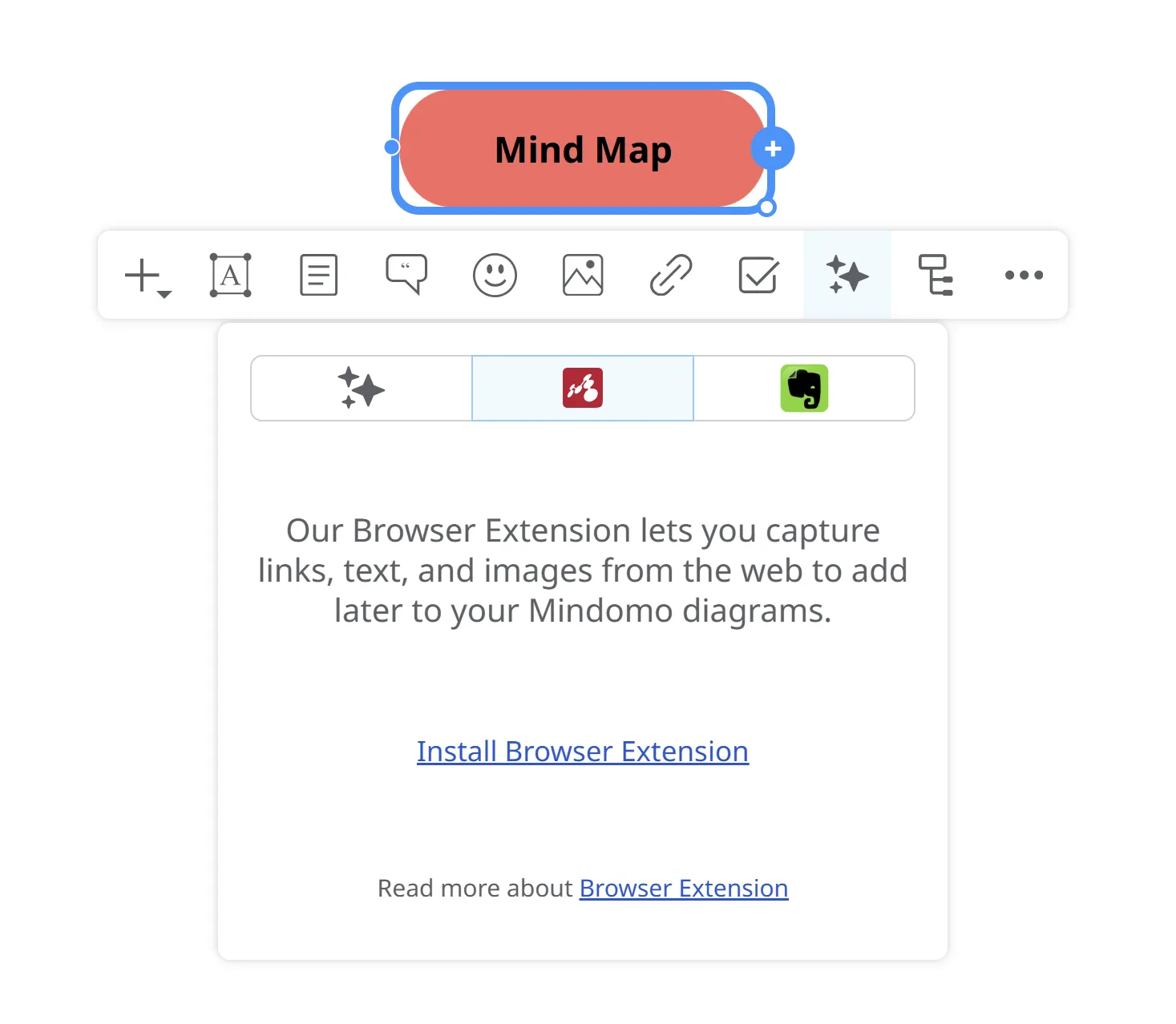
Students can also use saved Mindomo Bookmarks (text, links, or images) relevant to their research.
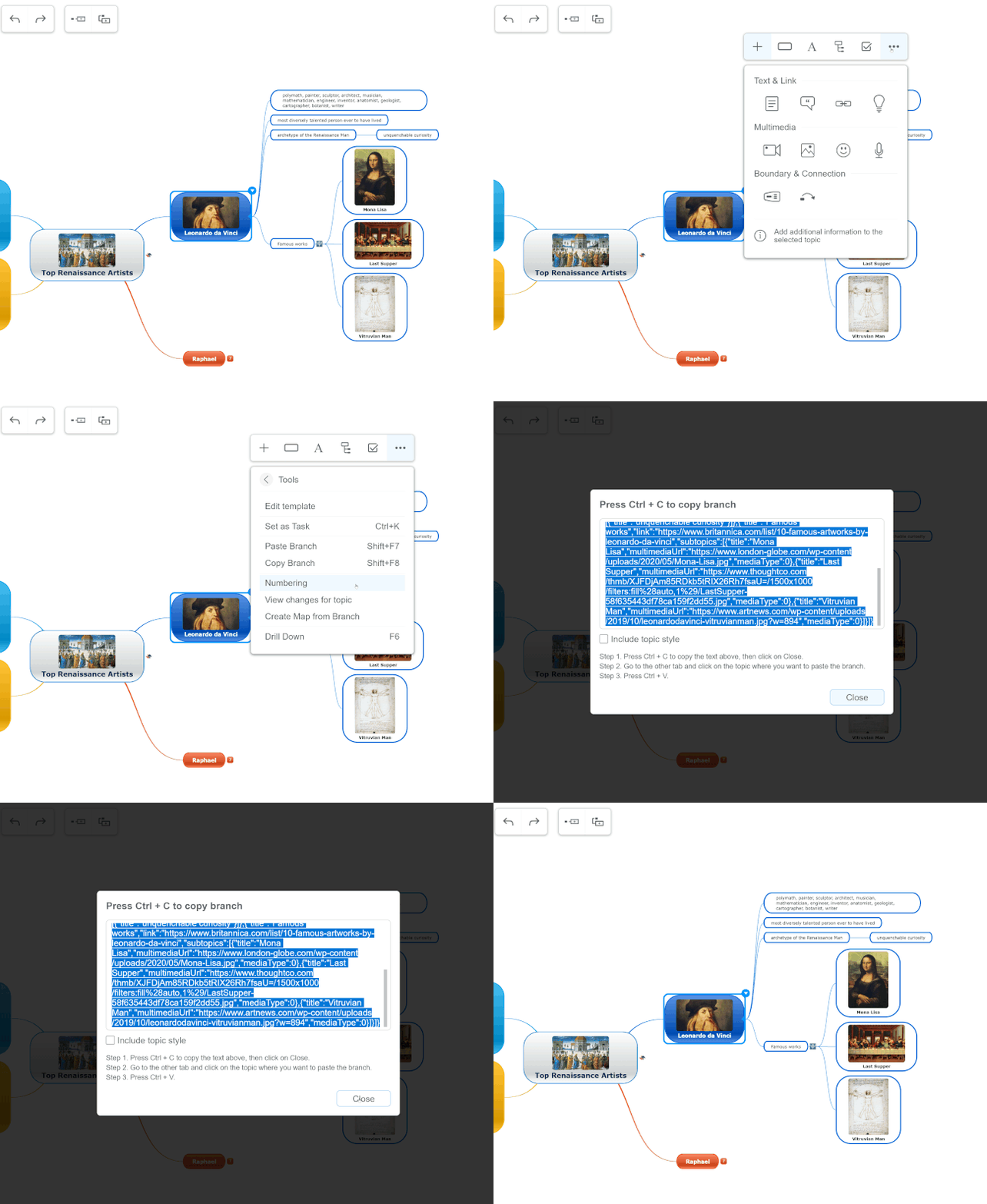
Copying and pasting content between maps—including links, images, notes, and other resources—is a time-saving feature. Learn more here.
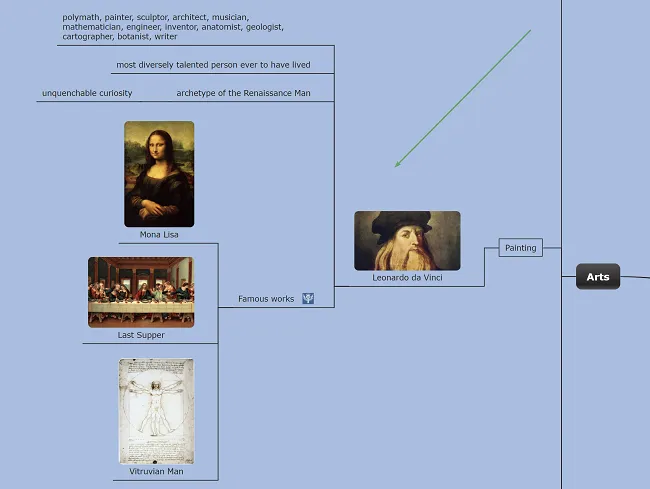
Using notes helps keep larger bodies of text hidden from the main view, such as long book excerpts, while remaining accessible when needed.
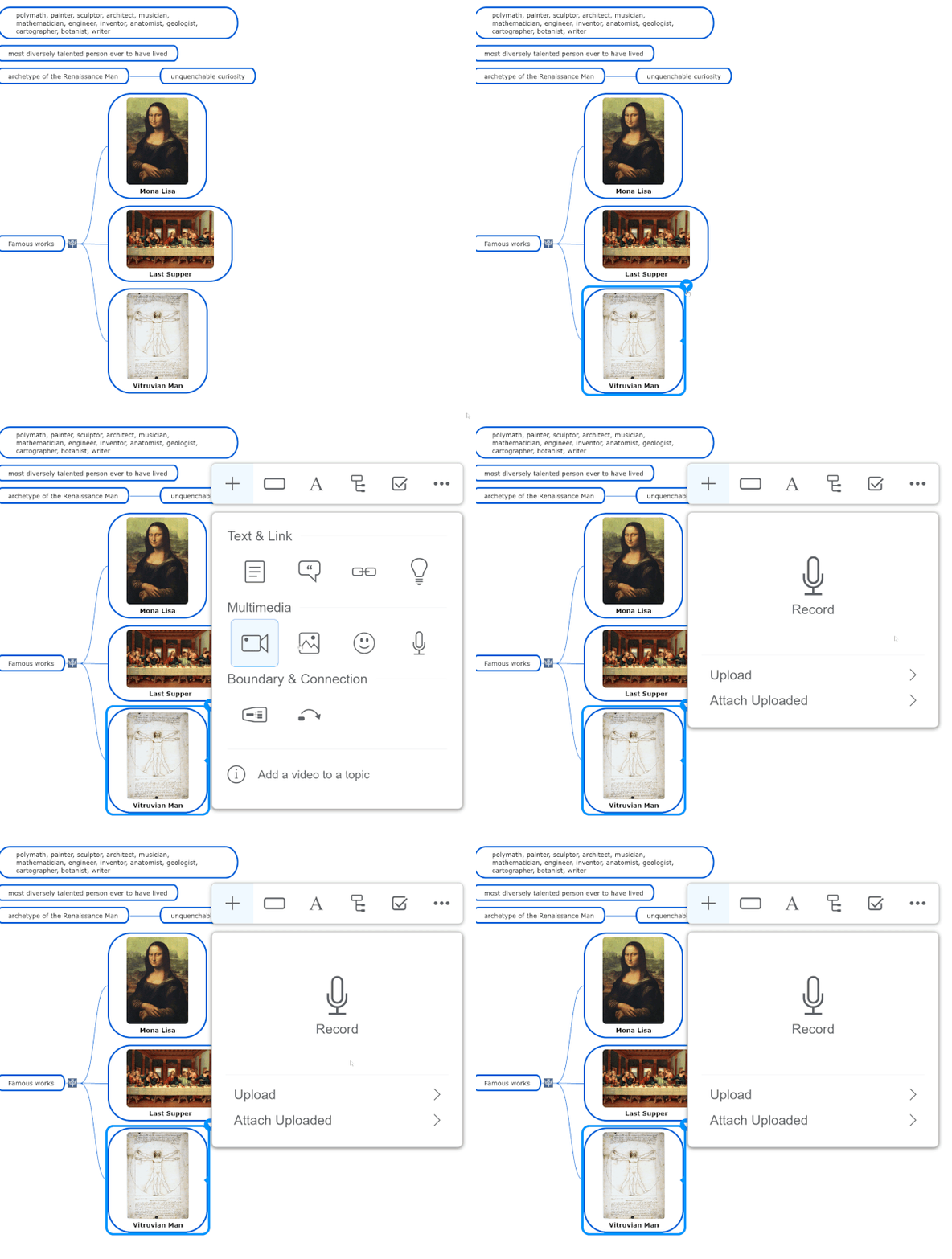
If students collect research data through observation or experimentation, they can add personal audio files or even record audio directly in Mindomo.
At any stage, no matter how complex a diagram becomes, students can quickly locate specific content using the Search and Filter options.
Inquiry Process
Section titled “Inquiry Process”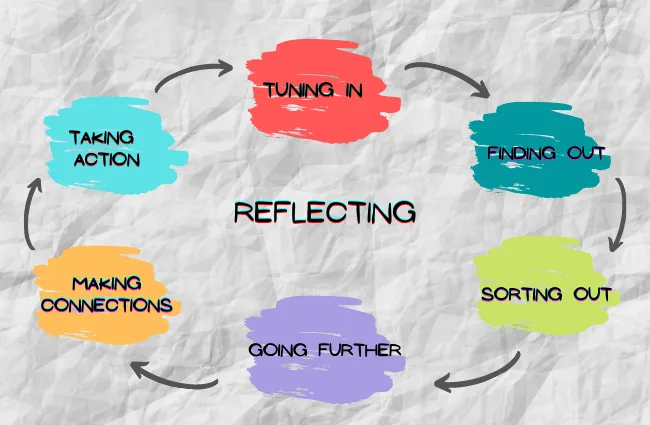
The inquiry process allows students to approach problems intuitively. Generally, this process involves four steps:
- Understanding the problem
- Making a plan
- Carrying out the plan
- Looking back to check the results
Teaching through the inquiry approach is beneficial because it:
- creates an environment that stimulates cooperative learning
- increases students’ engagement and sense of responsibility for their own learning
- helps students engage prior knowledge
- has cross-curricular links
- creates opportunities for peer evaluation and constructive feedback
Creating diagrams will give students the appropriate frameworks to construct their knowledge and explore ideas, questions, research, resources, findings, and solutions.
💡 Tips and Tricks
Encourage students to create diagrams using mathematician George Pólya’s four-step model. Trying various layouts will help students decide which one has the greatest visual impact for them.
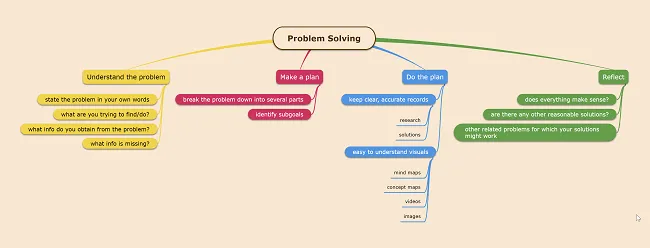
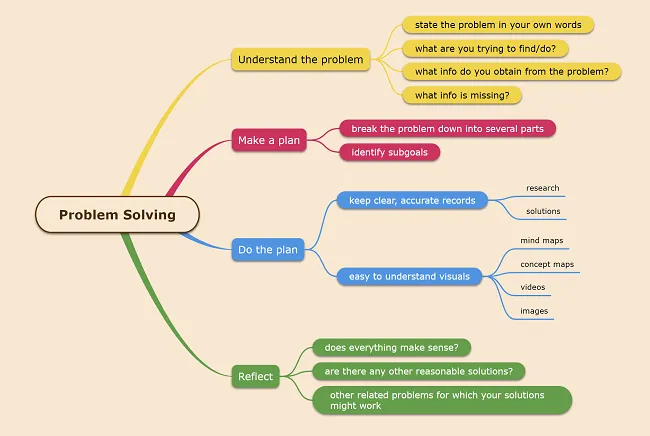
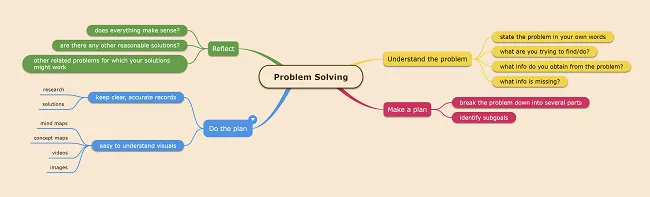
Feel free to use this problem-solving mind map in class as a starting point.
Customizing diagrams and adding resources gives students the flexibility to construct their own knowledge.
Sharing diagrams with classmates and teachers exposes students to the strategies used by their peers.
Teacher Activities with Mindomo
Section titled “Teacher Activities with Mindomo”Discover how Mindomo helps teachers stay organized and effective with daily routines, curriculum planning, course overview design, and cross‑curricular collaboration—turning visual diagrams into tools for planning, sharing, and teaching more efficiently.
Daily Routine
Section titled “Daily Routine”
Teaching contexts may differ from one educator to another, but there are challenges that almost all teachers can relate to:
- maximizing morning time before school starts
- getting things done during short planning periods
- wrapping up the day when there are many tasks left and energy is low
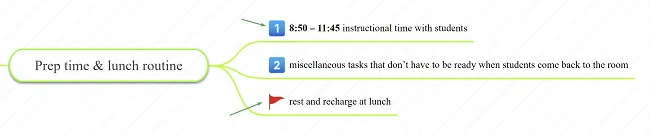
Diagrams can serve as springboards to streamline, simplify, and maximize your time.
💡 Tips and Tricks
Create a vivid work framework by keeping all your to-dos in mind and prioritizing them effectively.
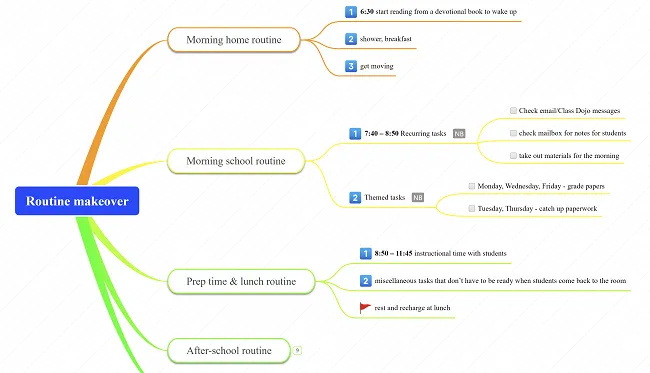
Get started with this daily schedule mind map.
Focus on what needs to be done to achieve more in less time. Self-assign tasks that you can later check off to visualize your progress.
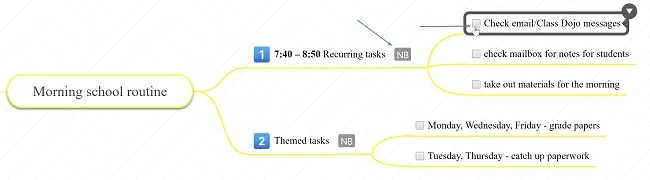
Use emojis to highlight priorities.
Curriculum Design
Section titled “Curriculum Design”
Curriculum planning involves deciding what will be taught, why it is taught, and how teaching and learning will be organized—while considering curriculum requirements and available resources.
Diagramming is an effective way to present units of study, key concepts that support inquiry, and related concepts that add depth and detail.
💡 Tips and Tricks
Create engaging diagrams and share them with colleagues. This approach helps involve a team with valuable insight into students’ needs when determining appropriate curriculum options.
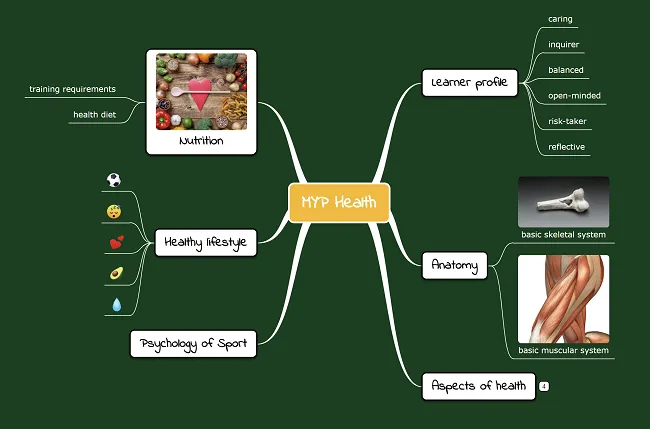
Use this curriculum mind map and adapt it to your specific needs.
Course Overview
Section titled “Course Overview”
A course overview introduces the course and outlines its structure and learning approaches. Core elements typically include:
- topics covered
- course objectives
- weekly schedule
- teaching methods and media
- tests, assignments, and grading weight
Digital diagrams are a highly visual and accessible way to organize and share syllabus-related information with both colleagues and students.
💡 Tips and Tricks
Adopt a student-centered approach and keep content simple, concise, and visually engaging.
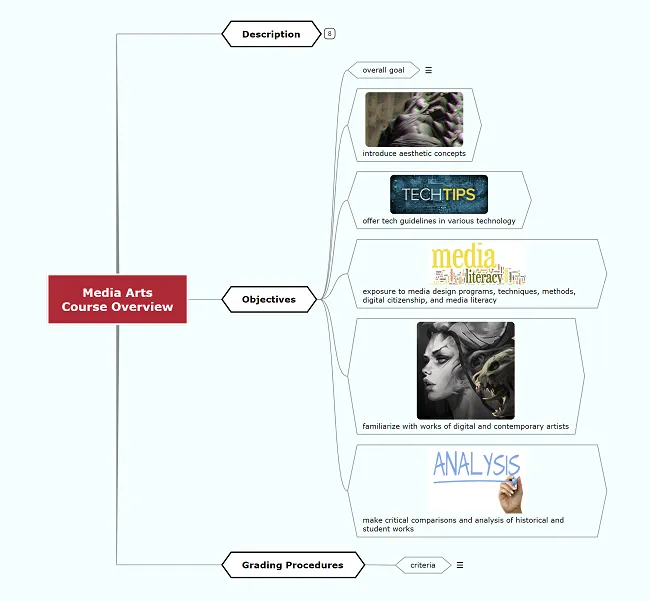
Explore this course overview mind map.
Create notes to include important details, such as evaluation criteria, course policies, and grading procedures.
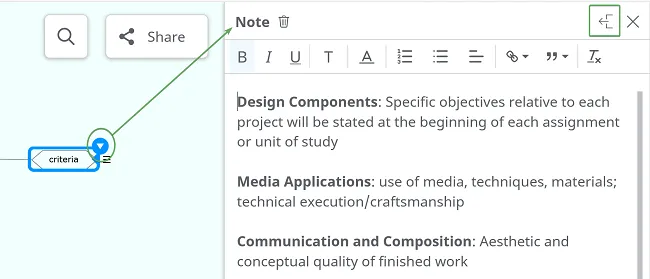
Share your overview as a mind map, concept map, or outline.
Cross-curricular Collaboration
Section titled “Cross-curricular Collaboration”
Collaborate with colleagues to create opportunities for students to engage in meaningful learning while strengthening communication, critical thinking, and problem-solving skills. Mind mapping helps exchange information, encourage peer engagement, and spark creativity.
💡 Tips and Tricks
Identify a shared focus between your class and a colleague’s class and begin collaborating. If you are using project-based learning (PBL), you can share the framework and invite feedback.
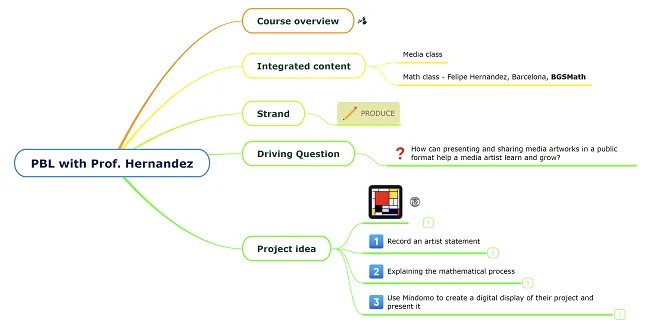
Use this PBL mind map as a starting point for your own diagram.
You can also create collaborative assignments where students from both classes connect and share knowledge, backgrounds, interests, and experiences.